The Higher You Go, the Less You Are Told

When you start out in product management, you get rewarded for knowing things. You know the product better than anyone in the room. Someone asks a question, you answer it. That is how you get noticed.
Then one day the job changes. Nobody tells you it changed.
You are not the person who knows the most any more. You are the person who has to work out what is really going on, from five people who each know one part of it.
That is when listening stops being a nice habit. It becomes the job.
Nobody lies to you. That is the hard part.
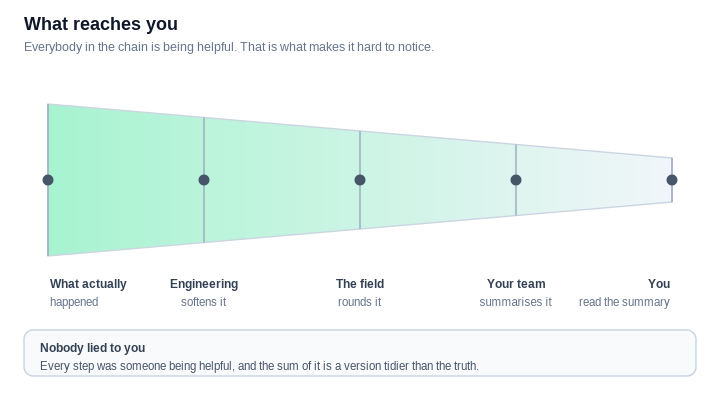
As you go up, your decisions get bigger. At the same time, what reaches you gets worse.
Nobody is lying. Everyone is being kind.
The engineer softens the estimate, because who wants to be the person who said no. The field team cleans up a messy customer complaint so it is easier to act on. Your own team gives you a summary instead of the raw thing, because that is their job and they are good at it.
By the time it gets to you, it has been helped.
I find this one hard to sit with. These are good people doing good work. The version you get is just neater than what actually happened. And neat is very easy to believe. It turns up on time, in the format you asked for, from someone you like.
A request is where their thinking stopped
A customer rarely tells you their problem. They tell you their answer to it. They worked it out without you.
Someone asks you to raise a configuration maximum. The number is not the problem. Eighteen months ago they made a design decision, and it walked them into a wall. That is the real story.
Raise the number and they will be back next year. Understand the design and you might find four more customers stuck in the same corner. Now you have something worth building.
Their request is where their thinking stopped. Your job starts there.
This is also why two pieces of advice that sound opposite are both right. Listen to your customers. Do not let your customers design your product. If you have only heard one of them, you will build the wrong thing twice.
Silence is not agreement
The engineer who argued in the last three design reviews and said nothing today has not changed their mind. They decided it was not worth it.
The customer who stopped raising issues is not happy. The field engineer who stopped escalating has not run out of problems. They stopped believing you would do anything about them.
That last one stings. Someone gave up on you, and they did not tell you.
Quiet is information. It always arrives late. By the time someone has gone quiet, the thing you needed to hear happened a while ago.
So worry about the meetings where everyone agreed quickly.
Your words got heavier. You did not notice.
This one sneaks up on people.
At some point what you say starts to weigh more. You throw out a sentence to keep a conversation moving. It becomes a line in someone's notes. Then a bullet on a slide. Then a commitment you do not remember making.
And everyone else's words get lighter, because now they are agreeing with you instead of arguing with you.
So you have to talk less. Not because you have less to say. Because it costs more when you say it.
That takes a while to get used to. It feels like holding back. It is not.
You are usually the only one who heard both sides
Engineering tells you what it costs to build. The field tells you what it costs not to have it.
Both are true. Neither is the whole thing. And those two groups are almost never in the same room on the same day.
You are often the only person who heard both in the same week. That is why the call lands with you. Not your title. That.
Most days, that is the job.
The hardest one is being told you were wrong
It is hardest right after you have said it out loud to a room. Which is exactly when it matters most.
You want to defend it. Your name is on it.
But look at who is telling you. They are taking a risk to say it. The easy thing was to stay quiet and let you find out in three months.
Being wrong for another quarter costs far more than saying so today. It never feels that way at the time. One cost happens now, in front of people. The other happens slowly, where nobody can point at it.
What it looks like on a normal Tuesday
None of this is a pose. It is a few small habits, and most of them feel awkward at first.
Ask the second question. The first answer is the one they prepared. The second one is usually the real one.
Write down what you heard, in their words. Read it back. If they correct you, you just learned the actual thing. It cost you one sentence.
Notice who went quiet. Go and find them after. Not in the meeting. After, on their own.
When you want to explain why they are wrong, wait. That is how most of us stop listening while still looking like we are listening.
Leave the silence alone. Give it a few seconds. People fill it with the thing they had decided not to say.
One last thing
Listening is not something you learn once and then have for good. It slips.
And it slips most when things are going well. That sounds backwards, so let me explain.
When something is on fire, you go and find out for yourself. You call the customer. You read the actual ticket. You do not trust the summary, because too much is riding on it.
When nothing is on fire, you do none of that. The update arrives on time. It is well written. Someone you like put it together. Nothing in it looks wrong, so you believe it and move on.
But the gap between the tidy version and the real version is still there. It did not close because the week was quiet. You just stopped checking.
That is the part worth watching. Bad news already gets your attention. Good news never does.
Never miss a post
New guides on VMware Cloud Foundation, Aria Suite, and infrastructure automation. Follow the blog in your feed reader and new posts show up as soon as they are published.
Using a different reader? Copy the feed URL and add it there.