VCF 9.1 Components and Who Upgrades Them

There are two useful questions to ask about any VCF 9.1 component. Where does it run, and who upgrades it.
The documentation answers both, in different tables on different pages. This puts them in one picture.
The whole thing in one map
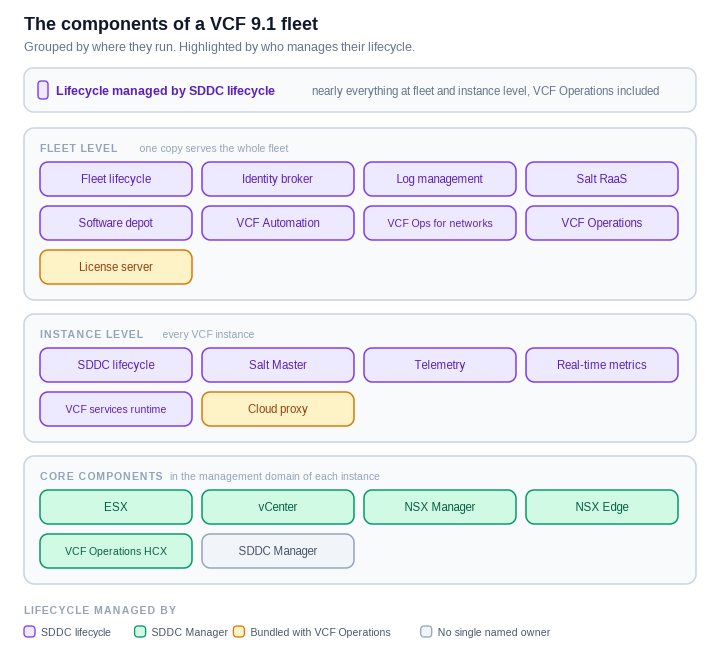
The colours cycle through the four lifecycle owners, one at a time, so you can read each set on its own rather than decoding a static key. The legend stays put at the bottom.
The thing the animation makes obvious is that ownership does not follow scope. The colours cut across the three tiers rather than lining up with them. A fleet level component and an instance level component can have the same lifecycle owner, and two components sitting side by side in the same tier can have different ones.
Fleet level and instance level
VCF 9.1 introduced VCF management services, a set of containerised components hosted on the VCF services runtime. They split by scope.
Fleet level components exist once and serve the whole fleet.
| Component | What it does |
|---|---|
| Fleet lifecycle | Orchestrates lifecycle operations across the fleet, planning and sequencing upgrades across instances |
| Identity broker | Connects an identity provider to the fleet for single sign-on |
| Log management | Logging and log analysis, added as a Day-N operation |
| Salt RaaS | Defines desired state configurations and policies |
| Software depot | The store for install, upgrade and patch binaries, and OCI images |
| VCF Automation | Self-service consumption. One instance per fleet |
| VCF Operations for networks | Network analytics |
| VCF Operations | The interface you drive all of this from |
| License server | Centralised licensing |
Instance level components run on every VCF instance. Each instance gets its own.
| Component | What it does |
|---|---|
| SDDC lifecycle | Install, update and patch of the VCF management components in that instance |
| Salt Master | Enforces configuration state on that instance's components |
| Telemetry | Sends telemetry to Broadcom |
| Real-time metrics | High-frequency performance data, added as a Day-N operation |
| VCF services runtime | The container host the others run on |
| Cloud proxy | Collects and monitors data locally in each instance |
Two of these have an "optionally, on other instances" note in the documentation. The identity broker and the software depot can be deployed to additional instances as a Day-N operation, so a second software depot on a remote instance is a supported design rather than a hack.
A note on where these came from. The documentation's component table carries an explicit deployment scope column only for the VCF management services. VCF Automation and VCF Operations for networks sit in the core components table, which has no scope column, so their fleet scoping is not something you can read off that page.
The pattern underneath is worth holding on to. Anything that has to agree across the fleet lives once, on the first instance. Anything that acts locally lives everywhere. Fleet lifecycle plans the upgrade; SDDC lifecycle in each instance carries it out. Salt RaaS holds the desired state; the Salt Master in each instance enforces it.
That is also why the first VCF instance is not interchangeable with the others, and why losing it is a different kind of problem from losing any other instance.
The core components
These are the ones that were there before 9.1 reorganised the management layer. They sit in the management domain of each instance.
| Component | Note |
|---|---|
| vCenter, ESX | The platform underneath everything |
| NSX Manager, NSX Edge | Networking |
| VCF Operations HCX | Workload migration between vCenter instances or clusters |
| SDDC Manager | Part of VCF Operations, covered below |
Who actually performs the upgrade
This is the part the map colour-codes, and it comes from four separate statements in the documentation rather than one table.
SDDC lifecycle performs "install, update, and patch procedures for the VCF management components in a VCF Instance". That covers every component in both tiers above, fleet level and instance level alike, including VCF Operations itself from 9.1 onward.
That last part is easy to get wrong, because the upgrade documentation describes getting a 9.0.x environment to 9.1 by uploading a PAK file directly into the VCF Operations administration interface. That is the one-time migration, not how it works afterwards. Once you are on 9.1, VCF Operations is upgraded by SDDC lifecycle like everything else.
SDDC Manager provides "lifecycle management for ESX, vCenter, HCX, and NSX". Despite the similar name it has nothing to do with SDDC lifecycle, which I went into separately in The Difference Between SDDC Manager and SDDC lifecycle.
Cloud proxy and the license server have no lifecycle of their own. The documentation is explicit: their lifecycle management "is bundled with the lifecycle management of VCF Operations", and upgrading VCF Operations upgrades them automatically. Two fewer things to plan a window for.
Follow that through and there is a chain worth knowing. SDDC lifecycle upgrades VCF Operations, and the VCF Operations upgrade carries the cloud proxy and the license server with it. Three components, one operation. Note also that they sit in different tiers: the license server is fleet level, the cloud proxy runs in every instance, and neither fact changes how they are upgraded.
One has no named owner. SDDC Manager is driven from VCF Operations, and the documentation does not hand it to a specific lifecycle component. The map shows it in grey rather than inventing an owner for it.
Where this shows up in practice
Patch order follows the ownership. Fleet lifecycle is patched before any other component, because it is the thing sequencing all the others. The 9.1.2 release notes say so in capitals and tell you not to press Upgrade All until you have complied. I went through that sequence in What Is New and What Is Fixed in VCF 9.1.2.
The software depot blocks everything while it patches. Because every other lifecycle operation depends on the binaries it holds, patching the depot stops the rest. That falls directly out of it being a fleet level component with one copy.
Version tracking only covers the core. The Component Versions tab in VCF Operations tracks SDDC Manager, vCenter, NSX Manager, ESX clusters and hosts, standalone hosts, and HCX. The management services components are not in that list, so drift detection there is not the same thing as drift detection across the whole fleet.
Sources
- Components in VCF and vSphere Foundation, for the component tables, their descriptions and the deployment scopes
- Lifecycle Management of VCF Components, for the bundled lifecycle of cloud proxy and license server, and the tracked component list
- VMware Cloud Foundation 9.1.2.0 Release Notes, for the patch order
Never miss a post
New guides on VMware Cloud Foundation, Aria Suite, and infrastructure automation. Follow the blog in your feed reader and new posts show up as soon as they are published.
Using a different reader? Copy the feed URL and add it there.