VCF Automation Config Maximums, 9.0 Through 9.1.1

Config Max publishes VCF Automation limits one release at a time. If you want to know whether the ceiling you planned against in 9.0 still holds in 9.1.1, you end up with four browser tabs open, reading across them and losing your place.
So here are all four releases on one page.
There is a second thing worth getting straight while you are here. The VCF Automation numbers Config Max publishes are the All Apps figures. A VM Apps organization runs to a different set, and that set is the vRealize Automation 8.x one. Both are below.
Everything here is taken straight from Config Max for the Scalability and Concurrency categories. Links to the exact filtered views are at the bottom.
Two organization types, and they do not share a ceiling
In VCF Automation 9.x an organization has a type, and the type decides which maximums apply to it.
All Apps organizations are what the published VCF Automation config maximums describe. Every number in the comparison tables below is an All Apps number.
VM Apps organizations run to the vRealize Automation 8.x maximums instead. Not a reduced version of the 9.x numbers, the actual vRA 8.x set, unchanged.
The important part is that this is about the type, not about how old the organization is. A VM Apps org created fresh in 9.1.1 today gets the vRA 8.x maximums, the same as one carried across from an 8.x environment.
Both sets are published per profile, Medium and Large. That is a different question from the size you choose in the planning workbook, which decides how many appliances you get rather than what they can hold. I went through that one in VCF Automation Sizing: What You Are Actually Choosing.
The short version
Three things fall out of reading all four releases together.
9.0.0 to 9.0.1 barely moved. The vKS cluster limits appeared and namespaces went up. Everything else stayed where it was.
9.0.1 to 9.1.0 is where the real jump happened. Organizations went up eight times on Medium and ten times on Large. Content libraries went up twenty one times and forty one times. A whole family of governance limits got published for the first time.
9.1.1 did not change a single existing number. Every value carried over from 9.1.0 untouched. What it did was publish five limits that were not there before.
That last one is worth sitting with for a second. If you are patching 9.1.0 to 9.1.1, nothing you sized against moves.
Where the numbers jumped, 9.0.1 to 9.1.0
Medium profile.
| Limit | 9.0.1 | 9.1.0 | Increase |
|---|---|---|---|
| Content libraries | 500 | 10,500 | 21x |
| Organizations | 500 | 4,000 | 8x |
| Namespaces across organizations | 1,500 | 10,000 | 7x |
| Managed vKS clusters | 200 | 1,000 | 5x |
| Regions per organization | 5 | 10 | 2x |
| Projects across organizations | 5,000 | 10,000 | 2x |
| Managed virtual machines | 140,000 | 150,000 | 1.1x |
Large profile.
| Limit | 9.0.1 | 9.1.0 | Increase |
|---|---|---|---|
| Content libraries | 1,000 | 41,000 | 41x |
| Organizations | 1,000 | 10,000 | 10x |
| Managed vKS clusters | 600 | 5,000 | 8x |
| Namespaces across organizations | 5,000 | 40,000 | 8x |
| Projects across organizations | 10,000 | 40,000 | 4x |
| Regions per organization | 10 | 35 | 4x |
| Managed virtual machines | 280,000 | 300,000 | 1.1x |
Content libraries is the one that stands out. Five hundred to ten and a half thousand on Medium, a thousand to forty one thousand on Large. If content libraries were the thing holding back your design on 9.0, that constraint is gone.
What 9.1.1 added
Five limits, all of them previously unpublished rather than changed.
| Limit | Medium | Large |
|---|---|---|
| Namespaces managed by ArgoCD | 10 | 30 |
| Subscriptions | 3,000 | 3,000 |
| Subscriptions per deployment | 40 | 40 |
| Blocking subscriptions per event topic | 50 | 50 |
| Non-blocking subscriptions per event topic | 50 | 50 |
The subscription numbers are worth a second look. Three thousand subscriptions, forty per deployment, fifty blocking and fifty non-blocking per event topic. Those are exactly the vRealize Automation 8.x numbers. The extensibility ceilings you already know carry straight over.
Full comparison, All Apps, Medium profile
Bold marks a value that changed from the release before it.
| Limit | 9.0.0 | 9.0.1 | 9.1.0 | 9.1.1 |
|---|---|---|---|---|
| Organizations | 500 | 500 | 4,000 | 4,000 |
| vCenter and NSX connections | 50 | 50 | 50 | 50 |
| Regions per organization | 5 | 5 | 10 | 10 |
| Region quota | – | – | 4,000 | 4,000 |
| Managed virtual machines | 140,000 | 140,000 | 150,000 | 150,000 |
| Managed vKS clusters | – | 200 | 1,000 | 1,000 |
| Collective policies per vKS cluster | – | 20 | 20 | 20 |
| Workloads | – | 7,000 | – | – |
| Workloads per vKS cluster | – | 100 | – | – |
| Namespaces across organizations | 1,000 | 1,500 | 10,000 | 10,000 |
| Namespaces managed by ArgoCD | – | – | – | 10 |
| Projects across organizations | 5,000 | 5,000 | 10,000 | 10,000 |
| Non-admin users per single project | – | – | 5,000 | 5,000 |
| Users per organization | – | – | 8,000 | 8,000 |
| Users across organizations | – | – | 100,000 | 100,000 |
| IP blocks | – | – | 20,000 | 20,000 |
| Virtual private clouds | – | – | 10,000 | 10,000 |
| Resources per deployment (VMs) | 100 | 100 | 100 | 100 |
| Catalog items (blueprints) | 8,000 | – | 20,000 | 20,000 |
| Content libraries | 500 | 500 | 10,500 | 10,500 |
| Approval policies | – | – | 4,800 | 4,800 |
| Lease policies | – | – | 4,000 | 4,000 |
| Day 2 action policies | – | – | 8,000 | 8,000 |
| IaaS resource policies | – | – | 3,200 | 3,200 |
| Subscriptions | – | – | – | 3,000 |
| Subscriptions per deployment | – | – | – | 40 |
| Blocking subscriptions per event topic | – | – | – | 50 |
| Non-blocking subscriptions per event topic | – | – | – | 50 |
| Max RTT to endpoints (ms) | 300 | 300 | 300 | 300 |
| Concurrent provisioning and Day 2 requests | 250 | 250 | 250 | 250 |
| Ops notification requests per 20 min | – | – | 500 | 500 |
A dash means that release did not publish the limit, not that the limit did not apply.
Full comparison, All Apps, Large profile
| Limit | 9.0.0 | 9.0.1 | 9.1.0 | 9.1.1 |
|---|---|---|---|---|
| Organizations | 1,000 | 1,000 | 10,000 | 10,000 |
| vCenter and NSX connections | 100 | 100 | 100 | 100 |
| Regions per organization | 10 | 10 | 35 | 35 |
| Region quota | – | – | 20,000 | 20,000 |
| Managed virtual machines | 280,000 | 280,000 | 300,000 | 300,000 |
| Managed vKS clusters | – | 600 | 5,000 | 5,000 |
| Collective policies per vKS cluster | – | 20 | 20 | 20 |
| Workloads | – | 21,000 | – | – |
| Workloads per vKS cluster | – | 250 | – | – |
| Namespaces across organizations | 1,500 | 5,000 | 40,000 | 40,000 |
| Namespaces managed by ArgoCD | – | – | – | 30 |
| Projects across organizations | 10,000 | 10,000 | 40,000 | 40,000 |
| Non-admin users per single project | – | – | 5,000 | 5,000 |
| Users per organization | – | – | 8,000 | 8,000 |
| Users across organizations | – | – | 200,000 | 200,000 |
| IP blocks | – | – | 100,000 | 100,000 |
| Virtual private clouds | – | – | 40,000 | 40,000 |
| Resources per deployment (VMs) | 300 | 300 | 300 | 300 |
| Catalog items (blueprints) | 10,000 | – | 75,000 | 75,000 |
| Content libraries | 1,000 | 1,000 | 41,000 | 41,000 |
| Approval policies | – | – | 22,500 | 22,500 |
| Lease policies | – | – | 20,000 | 20,000 |
| Day 2 action policies | – | – | 40,000 | 40,000 |
| IaaS resource policies | – | – | 17,500 | 17,500 |
| Subscriptions | – | – | – | 3,000 |
| Subscriptions per deployment | – | – | – | 40 |
| Blocking subscriptions per event topic | – | – | – | 50 |
| Non-blocking subscriptions per event topic | – | – | – | 50 |
| Max RTT to endpoints (ms) | 300 | 300 | 300 | 300 |
| Concurrent provisioning and Day 2 requests | 750 | 750 | 750 | 750 |
| Ops notification requests per 20 min | – | – | 500 | 500 |
A dash means that release did not publish the limit, not that the limit did not apply.
What never moved
Four limits are identical in all four releases, on both profiles. These are the ones you can plan against without checking the version.
| Limit | Medium | Large |
|---|---|---|
| vCenter and NSX connections | 50 | 100 |
| Resources per deployment (VMs) | 100 | 300 |
| Max RTT to endpoints (ms) | 300 | 300 |
| Concurrent provisioning and Day 2 requests | 250 | 750 |
The RTT number is the one people forget. Three hundred milliseconds round trip to your endpoints, and that has not moved since 9.0.0.
VM Apps, and what happens to your vRA 8.x org
Say you are running vRealize Automation 8.x today and your organization is called Arun-Org.
When you upgrade to VCF Automation 9.x, Arun-Org does not disappear and it does not become an All Apps organization. It comes across as the same Arun-Org, now with an org type of VM Apps. The deployments, cloud templates, projects, subscriptions and extensibility come with it.
Its maximums do not change. It ran to the vRealize Automation 8.x numbers before the upgrade and it runs to exactly the same numbers afterwards.
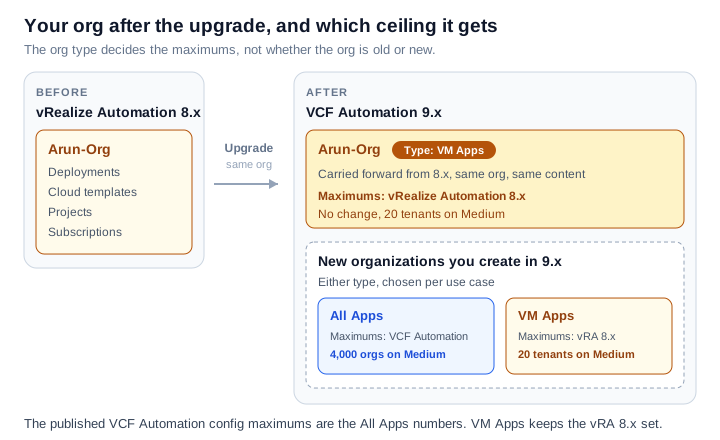
New organizations you create in 9.x can be either type, and you pick based on the use case. Choose All Apps and you get the maximums in the tables above. Choose VM Apps and you get the vRealize Automation set.
So after an upgrade you can quite reasonably be running both types side by side, each with its own ceiling. The mistake to avoid is planning Arun-Org against the All Apps numbers. Four thousand organizations and forty thousand projects are All Apps figures. They are not what a VM Apps org is sized to.
The limits that apply to a VM Apps org
These are the published vRealize Automation 8.6 maximums, scalability first.
| Limit | Medium | Large |
|---|---|---|
| Tenants | 20 | 50 |
| Cloud accounts, private endpoints (vCenter, NSX, NSX-T) | 50 | 50 |
| Cloud accounts, public endpoints (AWS, Azure, GCP, VMC) | 20 | 50 |
| ESXi hosts on a single vCenter | 600 | 600 |
| ESXi hosts across 50 vCenters | 2,000 | 2,000 |
| Cloud zones (all endpoints) | 200 | 200 |
| Cloud zones for a single endpoint | 10 | 10 |
| Data collected machines (private and public) | 200,000 | 280,000 |
| Images collected | 150,000 | 150,000 |
| Image and flavor mappings | 150 | 150 |
| Cloud zones and images per image mapping | 100 | 124 |
| Cloud zones and flavors per flavor mapping | 100 | 124 |
| VPZ from a single endpoint by provider tenant | 50 | 50 |
| VPZ across endpoints by provider tenant | 300 | 300 |
| VPZ assignment per tenant | 60 | 60 |
| Resources per deployment | 100 | 300 |
| Cloud templates | 8,000 | 10,000 |
| Catalog items | 8,000 | 10,000 |
| Catalog content sources | 1,000 | 2,000 |
| Projects across tenants | 5,000 | 5,000 |
| Projects per 5,000 admin users | 5,000 | 5,000 |
| Non-admin users in a single project | 5,000 | 5,000 |
| Projects that can contain 5,000 users | 50 | 50 |
| Projects a single non-admin user can join | 5,000 | 5,000 |
| Non-admin users across 5,000 projects | 50 | 100 |
| Custom roles across tenants | 500 | 1,000 |
| Custom roles per user | 100 | 500 |
| Subscriptions | 3,000 | 3,000 |
| Subscriptions per deployment | 40 | 40 |
| Blocking subscriptions per event topic | 50 | 50 |
| Non-blocking subscriptions per event topic | 50 | 50 |
| Approval policies | 4,500 | 4,500 |
| Pipelines | 3,000 | 5,000 |
| ABX actions, AWS Lambda and Azure Function providers | 1,000 | 2,000 |
| ABX actions, on-prem provider | 150 | 150 |
| HCMP active alerts | 70,000 | 70,000 |
| Max RTT to private endpoints (ms) | 300 | 300 |
Concurrency.
| Limit | Medium | Large |
|---|---|---|
| Concurrent provisioning, Day 2, ABX and vRO workflow requests | 250 active | 750 active |
| Concurrent pipeline executions | 20 per min | 50 per min |
| Bulk imported machines, multiple plans | 19,000 per hr | 30,000 per hr |
| Bulk imported machines, single plan | 3,500 per hr | 6,000 per hr |
Read "Tenants" as the vRA word for an organization and the gap is obvious. Twenty tenants on Medium here, against four thousand organizations on the All Apps side. That gap is the whole reason the two sets are kept apart.
Sources
Every number above comes from Config Max, Scalability and Concurrency categories.
- VCF Automation 9.1.1
- VCF Automation 9.1.0
- VCF Automation 9.0.1
- VCF Automation 9.0.0
- vRealize Automation 8.6
Captured on 19 September 2026. If you are reading this later, open the links and check, because Config Max is updated in place.
Never miss a post
New guides on VMware Cloud Foundation, Aria Suite, and infrastructure automation. Follow the blog in your feed reader and new posts show up as soon as they are published.
Using a different reader? Copy the feed URL and add it there.